

GREENLIGHT · INTELLIGENT ENTERPRISE
Intelligent Enterprise with Greenlight
AI that adapts to your enterprise, not an enterprise that adapts to AI. Your stack took years and a serious investment to build. Intelligent Enterprise uses Greenlight to layer AI onto the systems that already run the business: your ERP, CRM, data platforms and operational workflows. It puts that AI into production under governance without a migration, re-platforming effort or second transformation programme.
- Works on your systems of record, with no data migration
- Governed adoption, with a human sign-off where it counts
- Built for the enterprise you run, not a greenfield
The thing that stalls enterprise AI isn't the AI. It's the rebuild everyone assumes you'll do first.
Look closely at most AI proposals and they quietly begin with a migration. Move your data to a new platform. Re-platform the process around the model. Adopt someone's ecosystem so their AI has something to stand on. It's dressed as progress, but it's a second transformation programme bolted onto the one you haven't finished. Same risk profile, same timeline, same reason it slips.
So the pilot shines in a clean slice, then meets the enterprise you actually operate: decades of systems, integration debt, compliance that doesn't bend to accommodate new technology, data that lives where it lives. The "quick win" becomes a rebuild nobody scoped. The model was ready. The runway wasn't. And the investment sits idle while the platform question gets re-litigated for another two quarters.
Everything moves first.
Migration, re-platforming, months before anything reaches production, and the systems you already paid for get treated as the problem.
Nothing has to move.
Layer intelligence onto what already runs, govern it, and reach production in the environment you operate today.

You already run the enterprise. The last thing AI should ask is that you run it again from scratch.
We start from what you have already built.
Greenlight treats your existing landscape as the foundation, not the obstacle.
We don't move your data or rebuild your processes to make room for a model. We connect AI to the systems of record you already run, ground it in the context those systems already hold, and let it work across them, while your people retain the risk decisions assigned to them.
You keep everything that works. The AI meets your enterprise where it is.
Embracing a system means attaching intelligence to it without changing it.
Intelligent Enterprise connects through a governed context layer. We call it a Greenlight accelerator, and it is not a separate platform you have to adopt. It sits between the AI and the systems you already run, grounding AI in the enterprise without moving the enterprise.
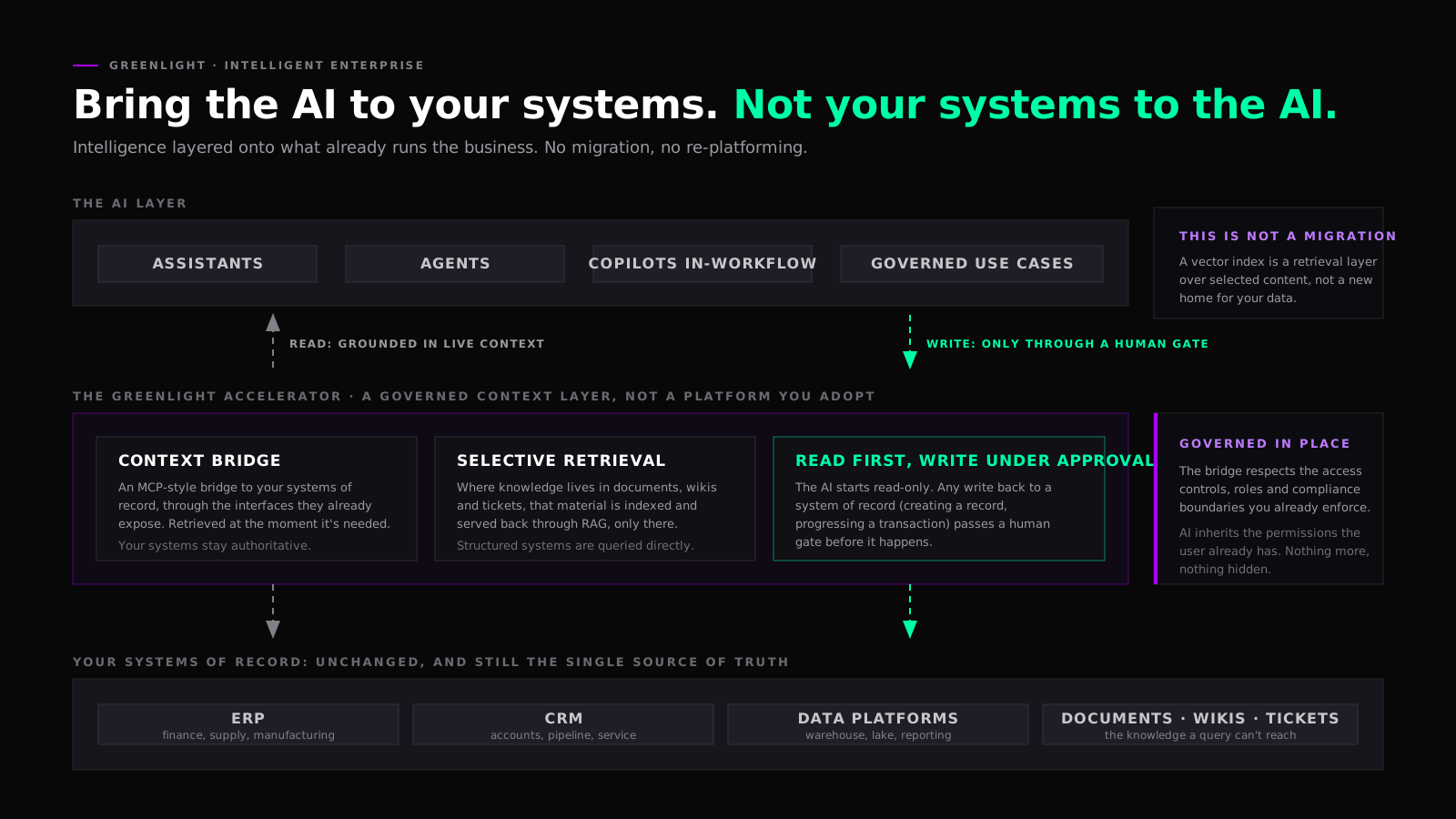
Live queries through existing interfaces
Vector index over unstructured content only
Read-only by default, write behind a gate
Your roles, access controls, compliance
Systems of record stay in place, unchanged and authoritative.
Your systems of record stay the single source of truth. A vector index is a retrieval layer over selected content, not a new home for your data. When a record changes, the answer changes with it, because the bridge reads from the source instead of from a copy.
We stand up the same reference architecture on every Enterprise engagement: accelerator, context bridge, selective retrieval, governed write-back. It gets tuned to your systems rather than rebuilt from scratch each time.
Production-safe from the first use case, not just the demo.
A pilot stalls at the production line because nobody built the controls the production line demands. Greenlight puts them in from the start.
Every use case begins with a real owner and a measurable outcome. An independent verifier checks proposed output against the source systems and agreed standard before it is trusted, and a person decides where risk requires approval. You prove value against your own baseline, then extend across teams under one governance model.
Governed acceleration first; autonomy only as the evidence earns it.
Protect the investment. Prove the return. Own the risk.
Protect the investment.
No migration and no forced modernisation to get started. The systems you've spent a decade and a budget on keep earning, now with intelligence layered on top rather than thrown away underneath.
Prove the return.
Every use case carries an owner and a metric, measured against your baseline. "AI adoption" stops being a slide and becomes a number you can take to the board: time-to-value, cost-to-serve, throughput.
Own the risk.
Role-based access, actions you can audit, and human approval at the decisions defined by your authority and risk model. When your board, your auditors, or your regulator asks where control lives, you can point to it in the flow.
Governed AI in the environment where "trust me" is never enough: public procurement.
 EQUALIS · KAIZENIQ
Equalis and KaizenIQ run cooperative purchasing for the public sector, where every solicitation, score and award is scrutinised and auditability isn't optional. Greenlight put AI to work across that process without changing the systems or the rules it runs on.
It's the whole model, running in the setting least willing to take AI on faith. Retrieval grounded in the documents already there, AI doing the volume, and a person owning every decision that carries weight. It doesn't dodge the governance question. It answers it.
Retrieval over the documentation you already hold. AI proposes. A human greenlights. It's the same model this page describes, running where the stakes and the scrutiny are highest.
Before you connect AI to your enterprise.
We start with your existing systems of record and assess their interfaces, permissions and data quality. Integration and configuration may be required; the aim is to add useful AI without making a wholesale platform replacement the starting point.
Structured information is queried through the context bridge. Selected documents, wikis and tickets may be indexed for retrieval. We agree the content scope, access controls and update approach before connecting the use case.
The starting point is read-only access. Writes back to systems of record pass a human approval gate, with permissions and responsibilities agreed for the use case.
Bring a priority workflow, its business owner and an outline of the systems and data it uses. We assess access, integration requirements and the measures that would demonstrate value before agreeing the next step.

See what AI on your existing systems is worth before you commit to scale.
Book an AI governance and readiness assessment. We map your landscape, the systems your priority use cases would touch, and where AI can be layered on and taken to production fastest. No rebuild on the table.