How architecture shapes agentic AI costs
- Agentic AI cost grows super-linearly, not linearly: cheaper tokens don’t change the curve’s shape.
- Four architecture gaps drive the spend: weak data, agent sprawl, manual governance, integration gaps.
- Gartner expects 40%+ of agentic AI projects canceled by 2027; MIT NANDA found 95% of GenAI deployments return nothing.
- The fix is systemic: caching, deterministic orchestration, lightweight guardrails, and model cascading, for a realistic 60 to 80% reduction in total cost of ownership.
When token invoices spike, teams blame the model and chase cheaper tokens. The real driver is the architecture around it, weak data, agent sprawl, manual governance, and integration gaps.
Agentic AI cost is the line item quietly killing enterprise AI programs, and most teams are blaming the wrong thing. When token invoices spike, the reflex is to negotiate cheaper models. But the real driver isn’t model pricing; it’s agentic AI architecture. Weak data, agent sprawl, manual governance, and integration gaps force non-deterministic models to burn millions of redundant tokens. Fix the architecture, and the bill follows.
Why agentic AI cost behaves differently
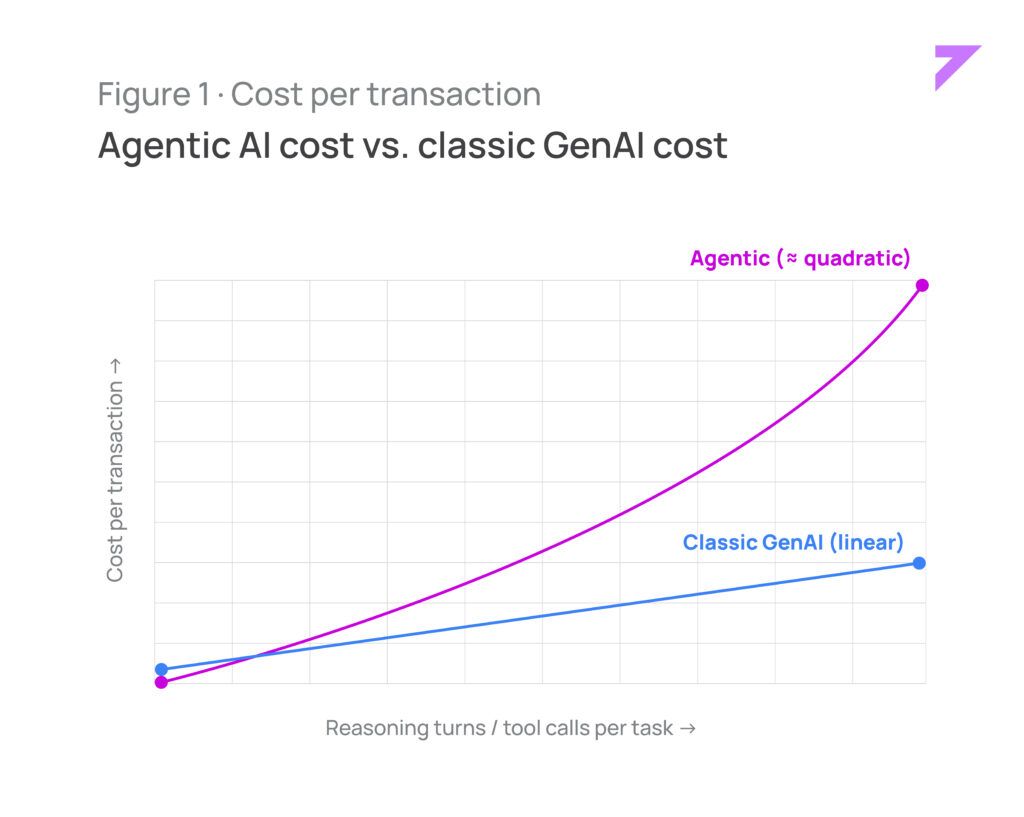
A standard generative call is cheap to reason about: one request in, one completion out, paid once. Cost scales linearly with usage. An agentic system breaks that. A single request triggers a cascade, planning, tool calls, data re-hydration, self-correction, and every loop re-pays for the context that came before it. The curve bends upward as tasks get longer.
This isn’t fringe. Gartner forecasts that more than 40% of agentic AI projects will be canceled by the end of 2027, citing escalating costs, unclear value, and weak risk controls. The MIT NANDA initiative found 95% of organizations seeing zero return on an estimated $30–40B in GenAI investment, tracing failures to integration brittleness and architecture, not model capability.
The four architecture gaps driving agentic AI cost
Every runaway agentic AI bill traces back to one or more of these gaps. None of them is “the model is too expensive.”
GAP 1: Weak data
100K-token schemas, full API docs and PDFs dumped into context, the model re-reads them every turn to find one field. You’re paying a frontier model to do data cleansing.
Fix
Typed JSON data contracts + verified semantic cache (vCache: up to 12.5× cache hits).
GAP 2: Agent sprawl
Zero-shot autonomy and multi-agent swarms loop more than they deliver. The MAST study found 14 failure modes; more agents usually meant more failure surface.
Fix
Deterministic state-machine choreography (LangGraph, Temporal) + token circuit breakers.
GAP 3: Manual governance
An LLM-as-a-Judge on every step. With N criteria × M steps you multiply the bill by an order of magnitude before the user sees a word.
Fix
Lightweight perimeter guardrails (NeMo, Llama Guard); deep eval async, off the hot path.
GAP 4: Integration gaps
Raw HTTP errors from legacy systems become puzzles the agent reasons through, thousands of tokens to decode what a clean code would have said instantly.
Fix
Microservice wrappers returning {"code":"RATE_LIMIT"}, a signal, not a riddle.
The agentic AI architecture that controls cost
Stop treating the foundation model as the whole application. Treat it as one replaceable component inside a deterministic, decoupled system. Four levers do the heavy lifting, each backed by published results.
The four levers: Architecture moves and their evidence:
| Lever | Architecture move | Evidence |
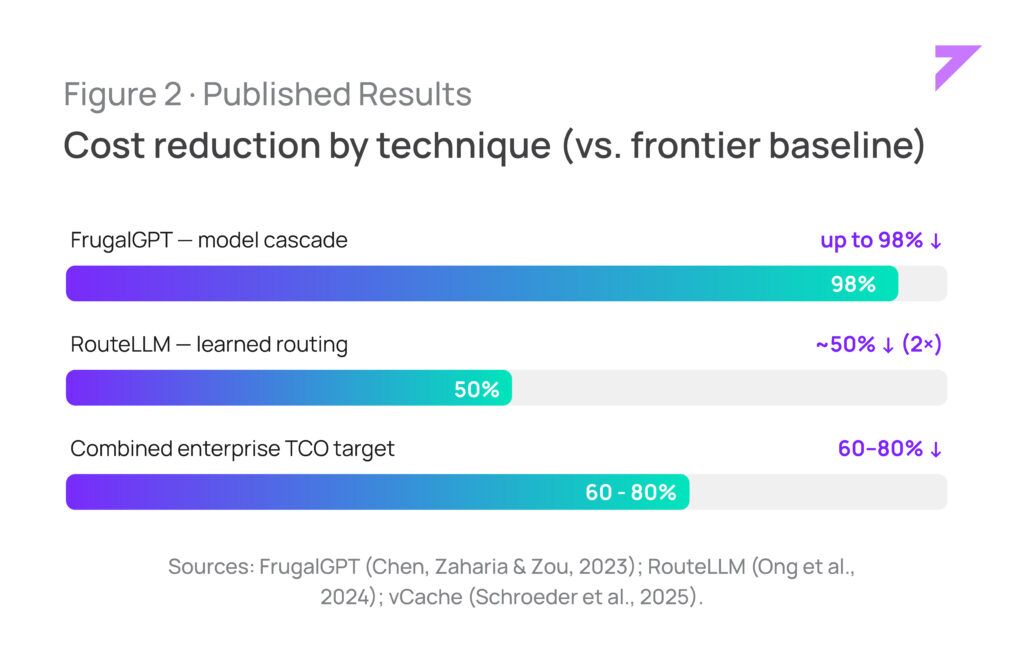
| Asymmetric model topology | Small models route, format and parse; frontier models reserved for real reasoning. | FrugalGPT: up to 98% ↓; RouteLLM: ~2× ↓ |
| Semantic caching | Repeat intents resolve from cache at near-zero marginal cost. | vCache: up to 12.5× cache hits |
| State-machine choreography | Graph networks bound where the agent goes and how often it loops. | MAST failure taxonomy |
| Integration abstraction | Typed JSON error contracts stop recursive “reason through the error” loops. | MIT NANDA root-cause |
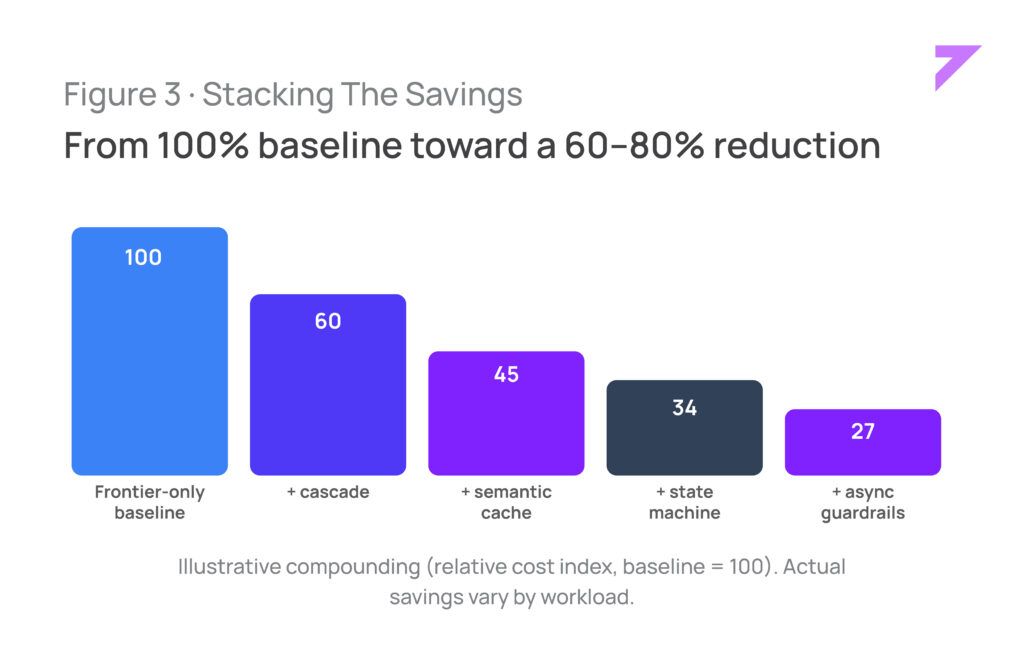
These compound. Routing cuts the per-task rate, caching bills repeated work once, state machines and circuit breakers kill the runaway tail, and async guardrails remove the judge from the hot path.
A 5-point checklist to cut agentic AI cost
- Token circuit breakers — hard caps on iteration depth (e.g. 8 turns) and session spend, with graceful trip and human escalation.
- An enterprise AI gateway — centralized semantic caching, automatic model cascading, async perimeter guardrails.
- An integration abstraction layer — every legacy system behind a microservice that returns typed JSON errors.
- 12-Factor decoupling — all agent state externalized to a memory fabric; nothing floats in the context window; per-step token telemetry.
- Compute-task mapping — every micro-task routed to the cheapest tier that can run it safely.
Frequently asked questions
Cost is driven by architecture, not model pricing. Agents loop, and each loop re-processes accumulated context. Weak data, unbounded autonomy, synchronous governance, and brittle integrations multiply the tokens per task, so agentic AI cost grows super-linearly with task complexity.
No. A lower price-per-token scales a runaway cost curve down by a constant factor but leaves its super-linear shape intact. The leverage is in the architecture, caching, orchestration, governance placement, and model cascading.
FrugalGPT showed up to 98% cost reduction through model cascading, and RouteLLM roughly halved cost via routing. Combined across the four levers, a 60–80% reduction in total cost of ownership is a realistic enterprise target.
Gartner attributes its 40%+ cancellation forecast to escalating cost, unclear value, and weak risk controls. MIT NANDA’s 95% “zero return” finding points to integration brittleness and forcing models to clean their own data, architecture problems, not model problems.
Originally published on softobiz.com, Jul 2026. Canonical version.