
Best AI Consulting Firms for QSR Supply Chain Automation: A 2026 Buyer’s Guide
The best AI consulting firms for QSR supply chain automation are not chosen by brand recognition alone. They are chosen by whether they can connect live restaurant demand with inventory, replenishment and supplier decisions without disrupting service.
That is harder than it sounds. A quick-service restaurant network generates signals across point-of-sale systems, kiosks, mobile apps, loyalty platforms, inventory tools, workforce systems, ERP platforms and supplier portals. A strong model sitting outside that operating environment will not reduce waste, prevent stock-outs or improve decision speed.
This guide gives QSR leaders a practical way to compare AI consulting partners in 2026. It focuses on the capabilities, delivery models and evidence that matter when the goal is a dependable supply-chain decision system, not a one-off AI demonstration.
Key takeaways
- The best partner is the one that can operate across restaurant, data and supplier boundaries, not simply build an accurate forecast.
- Integration and delivery ownership should carry as much weight as AI architecture when evaluating firms.
- A credible proof of value should run in shadow mode, use an agreed baseline and end with a clear scale, refine or stop decision.
- Governance must cover data quality, model performance, human approvals, exceptions and recovery procedures.
- Softobiz is strongest when a QSR needs an engineering partner to connect AI, data and existing operational systems. An off-the-shelf planning suite may be simpler when custom integration is limited.
Best AI consulting firms for QSR supply chains start with the operating constraint
QSR supply chains are exposed to short planning windows, local demand variation, promotions, weather, delivery availability, shelf life and franchise operating differences. The commercial objective may sound simple, such as improving forecast accuracy, but the operating constraint is usually elsewhere.
A restaurant may already have a reasonable forecast and still over-order because the forecast never reaches the replenishment workflow. Another may have accurate store-level demand data but no dependable product mapping between POS, recipe, inventory and supplier systems. A third may automate purchasing but lack the controls to prevent a poor recommendation from propagating across hundreds of locations.
Start the selection process by defining the decision that must improve. Is the business trying to forecast item demand, set order quantities, detect stock risk, optimise transfers, reduce emergency purchasing or improve supplier planning? Then identify who owns that decision today, what systems it touches, how frequently it is made and what happens when the recommendation is wrong.
This operating definition prevents a common buying mistake: selecting a provider for the sophistication of its AI demonstration before confirming that it can change the real workflow.
Seven criteria for evaluating QSR supply chain AI partners
A weighted scorecard makes trade-offs visible and gives operations, technology, finance and procurement teams a shared basis for comparison. The following weighting is a useful starting point. Adjust it before proposals are reviewed, not after a preferred vendor emerges.
1. AI and decision architecture: 20%
Assess whether the proposed design supports the whole decision loop: signal capture, prediction, recommendation, approval, action, monitoring and learning. Ask how the firm handles sparse history, new stores, promotions, local events, substitutions and sudden demand shifts. The answer should include uncertainty and exception management, not only a single forecast accuracy score.
2. POS-to-supplier integration: 20%
Integration should carry equal weight because supply-chain value appears only when recommendations move into operating systems. Look for experience with APIs, events, batch feeds, master-data reconciliation, identity, observability and failure recovery. The firm should be able to explain how it will connect restaurant transactions to inventory, ERP, planning and supplier workflows without creating a fragile point-to-point estate.
3. QSR operating fit: 15%
Generic retail knowledge is useful but insufficient. QSR work requires an understanding of recipes, ingredients, shelf life, dayparts, promotions, store formats, delivery channels and franchise variation. Evaluate whether the delivery team can work with restaurant operations and supply-chain leaders in their language, not only with data specialists.
4. Delivery ownership: 15%
Clarify who will own discovery, data remediation, integration, model engineering, workflow design, rollout and support. Some firms advise and hand over. Others provide a product and expect the client to integrate it. An engineering partner should accept responsibility for the path into production and define the client responsibilities with equal precision.
5. Governance and operational safety: 12%
Governance should be built into the workflow. Buyers should expect model and data monitoring, role-based access, decision logs, approval thresholds, escalation paths and a practical fallback when data or services fail. The NIST AI Risk Management Framework offers a useful structure through its Govern, Map, Measure and Manage functions.
6. Measurable business value: 10%
Require a measurement plan before implementation begins. Useful measures may include forecast bias, stock-out rate, waste, emergency orders, transfer activity, planner time and service impact. Every metric needs a baseline, a data source, an owner and a review cadence. Avoid claims that cannot be separated from seasonality, pricing changes or other operational programmes.
7. Commercial clarity and team continuity: 8%
Compare the named delivery team, not only the pitch team. Ask about senior involvement, replacement rules, knowledge retention, support coverage and the cost of moving from proof to production. A lower initial price can become expensive if the client must rebuild integrations or reassemble delivery knowledge after launch.
Choose the delivery model before you choose the firm
The phrase AI consulting firm covers several different delivery models. Each can be the right choice, but they should not be compared as if they provide the same thing.
AI engineering partner
Best suited to QSRs that need to connect several existing systems, build differentiated decision logic and retain flexibility over time. The trade-off is that the client must participate in product ownership and change management.
Supply-chain planning platform
Best suited to organisations seeking established forecasting and planning capabilities with a defined product roadmap. The trade-off is that restaurant-specific integrations and workflows may require additional services or process change.
Restaurant operations platform
Best suited to businesses prioritising store execution, food operations and restaurant-level visibility. The trade-off is that supplier planning or enterprise-wide optimisation may sit outside the product's strongest scope.
Broad enterprise supply-chain suite
Best suited to complex enterprises that want planning, execution and control-tower capabilities under a strategic platform. The trade-off is a larger transformation footprint, longer implementation path and greater process standardisation.
Data and AI consultancy
Best suited to organisations that need strategy, data foundations and custom modelling. The trade-off is that production integration and ongoing operation may depend on a separate engineering or platform team.
Decision automation platform
Best suited to teams that need governed workflows and rapid automation across existing systems. The trade-off is that the QSR supply-chain logic and operating model still have to be designed, validated and owned.
A strong shortlist can contain more than one model. The important point is to score each candidate against the required outcome and be explicit about the work that remains with the client.
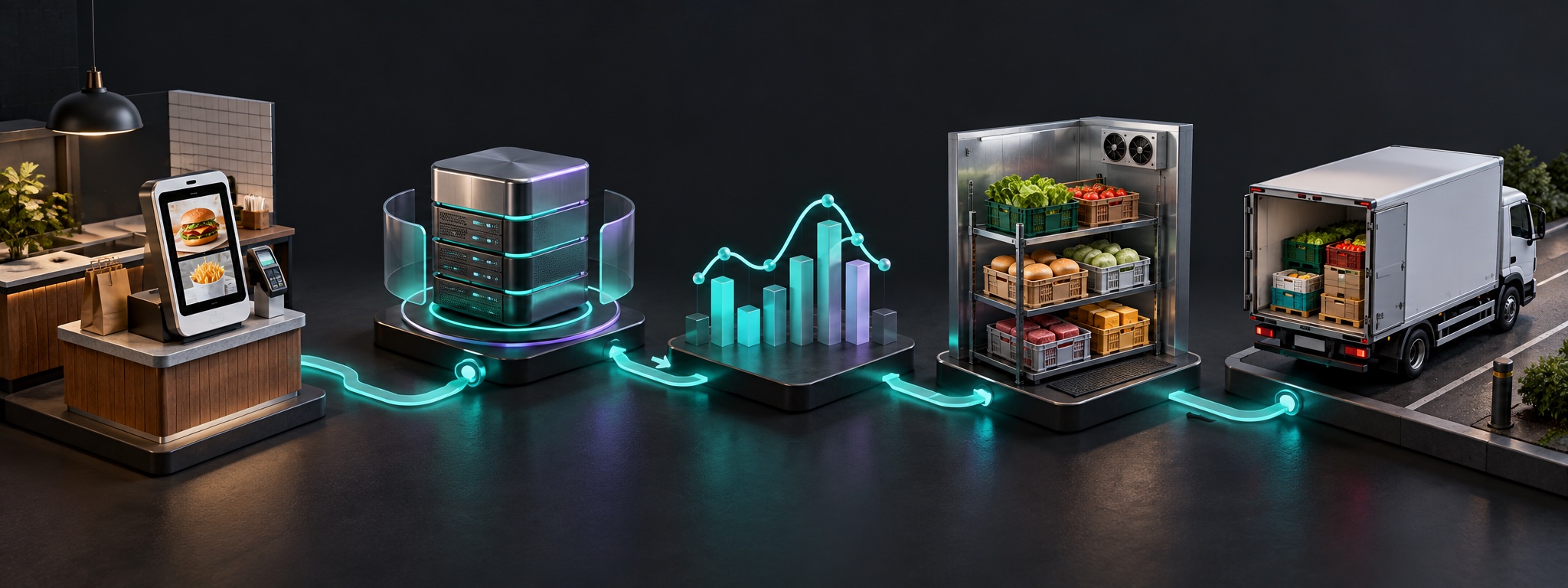
The architecture must connect POS to supplier decisions
The core architecture should create one controlled path from demand signal to supply action. In practical terms, that usually means five connected layers.
- Signal layer: POS transactions, digital orders, promotions, loyalty activity, local events, weather and operational status.
- Data layer: governed product, recipe, location, inventory and supplier data with observable pipelines and clear ownership.
- Decision layer: demand forecasts, order recommendations, risk detection and scenario logic with confidence and constraints.
- Workflow layer: approvals, exceptions, notifications and role-based actions for planners, franchisees and operations teams.
- Execution layer: ERP, replenishment, inventory, logistics and supplier systems that complete and confirm the action.
This is why the strongest programmes combine QSR systems integration, data and analytics engineering and demand forecasting. Improving only the model layer can create a more accurate recommendation that still arrives too late, cannot be acted on or cannot be trusted.
Architecture decisions should also anticipate scale. A pilot that works for ten stores can fail across a network if every integration is synchronous, every exception requires a central analyst or every franchise location uses slightly different reference data. Ask providers to explain throughput, resilience, tenant or franchise boundaries, monitoring and support at the intended production scale.
Evidence QSR buyers should demand
Case studies matter, but buyers should test what the evidence actually proves. A restaurant integration result demonstrates different capability from a supply-chain forecasting result. Both are valuable, but they should not be presented as interchangeable.
- Production evidence: Was the solution operating in live environments, and for how long?
- Integration evidence: Which systems and data domains were connected, and who owned the interfaces?
- Metric integrity: What was the baseline, time period and source of the reported result?
- Operating evidence: How were exceptions, user adoption, support and failed recommendations handled?
- Ownership evidence: Which people delivered the work, and will comparable seniority be assigned to the new engagement?
Softobiz's published QSR experience includes restaurant data and integration work for Hungry Jack's, with a reported 20% reduction in wait time. That is relevant evidence of restaurant integration and operational engineering. It should not be treated as proof of a standalone supply-chain forecasting outcome. This distinction is exactly what a credible evaluation process should preserve.
What a credible 90-day proof should deliver
A proof of value should reduce decision risk, not postpone it. Ninety days is usually enough to test a bounded workflow if data access, operating ownership and success measures are agreed at the start.
Weeks 1 to 3: define the decision and baseline
Select one decision, a representative store or region set, and a small number of outcomes. Map the current workflow, exceptions and system dependencies. Establish baseline performance and data-quality issues before evaluating any model.
Weeks 4 to 7: connect data and build the decision service
Create the minimum reliable data path, reconcile master data and build the forecast or recommendation service. Add monitoring, approval thresholds and decision logs at this stage. Governance added after the model is finished usually becomes an incomplete wrapper.
Weeks 8 to 10: run in shadow mode
Generate recommendations alongside the existing process without automatically changing orders. Compare outcomes, review errors with operators and identify where missing context or business constraints affect the result. Shadow mode turns operational feedback into evidence without exposing the network to uncontrolled automation.
Weeks 11 to 13: make a scale, refine or stop decision
Evaluate the agreed metrics, integration reliability, user acceptance, operating effort and support model. The final output should include the economics of scaling, the remaining risks and a clear recommendation. A successful proof is not merely a model that worked. It is a decision system with a credible path to production.
Where Softobiz fits
Softobiz is a strong fit for QSR organisations that need an engineering partner across AI, data, integration and operational workflow. The team can work across restaurant channels and enterprise systems, build the data and decision layer, and remain embedded through production and improvement.
This model is particularly relevant when a QSR wants to preserve existing POS, ERP or supplier investments while adding a governed AI capability around them. Softobiz's AI platform engineering and data capabilities support that approach, while the company's QSR work provides context for restaurant operations and integration.
The trade-off should be explicit. If the requirement is a largely standard planning process, limited custom integration and a preference for configuration over engineering, an off-the-shelf supply-chain platform may be the simpler choice. If the requirement depends on proprietary workflows, fragmented systems or differentiated restaurant operations, an engineering-led partner becomes more valuable.
Softobiz should therefore be evaluated on delivery fit, architecture, team and evidence alongside other qualified options. No provider should be selected solely because it appears first in a self-authored ranking.
A shortlist should make trade-offs visible
Use the same questions for every candidate and require written answers tied to the proposed team and architecture.
- Which supply-chain decision will improve first, and how will the baseline be established?
- Which restaurant, data, ERP and supplier systems are in scope?
- Who owns data remediation and interface reliability?
- How are uncertainty, exceptions and human approvals handled?
- What happens when a source system, model or workflow fails?
- Which named people will deliver the proof and the production rollout?
- How will value be measured separately from other operational changes?
- What does the production operating model cost after the initial proof?
Score the responses before commercial negotiation. A candidate that is strong in architecture but weak in integration should not be allowed to hide that gap inside a blended presentation score.
Frequently asked questions
What should a QSR automate first?
Start with a high-frequency decision that has reliable data, a clear owner and measurable consequences. Store or item demand forecasting, replenishment recommendations and stock-risk alerts are common starting points, but the right choice depends on where the current workflow loses value.
Should a QSR choose a platform or a consulting partner?
Choose a platform when the required process is standard and the organisation can adapt to the product. Choose an engineering or consulting partner when value depends on custom integration, proprietary decision logic or a differentiated operating model. Some programmes use both, with a platform for core planning and an engineering partner for integration and workflow.
How should AI accuracy be evaluated?
Use business-relevant measures at the level where decisions are made. Aggregate forecast accuracy can conceal systematic errors by store, daypart or item. Review bias, error distribution, confidence, service impact and the cost of false recommendations, then compare performance with the existing decision process.
How long does QSR supply chain AI implementation take?
A bounded proof can often be structured within 90 days when data access and ownership are ready. Production rollout depends on integration complexity, data quality, store diversity, governance and change management. Providers should give milestone-based ranges after discovery rather than promise a universal timeline.
The best partner is the one that can operate the decision
The best AI consulting firms for QSR supply chain automation combine modelling with data foundations, systems integration, workflow design, governance and production ownership. Their value is not the ability to predict demand in isolation. It is the ability to help a QSR make a better supply decision repeatedly, safely and at network scale.
Build the shortlist around the operating constraint, weight the criteria before reviewing proposals and insist on evidence that matches the outcome being purchased. If your QSR needs to connect restaurant demand with inventory and supplier decisions, talk to Softobiz about a focused discovery and proof plan.
Methodology note: This article presents a buyer's framework based on QSR operating requirements, Softobiz's published delivery evidence and public AI risk-management guidance. It is not an audited third-party ranking.