
Best AI-Enabled GCC Partners in 2026: An Enterprise Buyer’s Guide
The best AI-enabled GCC partners do more than recruit a team or add an AI centre of excellence to an existing offshore model. They design a capability centre where product ownership, data, engineering, governance and talent development work as one operating system.
That distinction matters in 2026. Enterprise leaders are no longer asking whether a Global Capability Centre can supply capacity. They are asking whether it can own platforms, move AI into production, retain institutional knowledge and improve business outcomes without weakening control. This guide provides a practical way to compare potential partners against that mandate.
It is a best-fit framework, not a vendor ranking. The right partner depends on the constraint that will limit your GCC after launch: operating-model clarity, engineering depth, talent, governance, innovation or the ability to scale ownership over time.
Key takeaways
- The strongest AI-enabled GCC is designed around an enterprise mandate and decision rights, not a headcount target.
- AI, data and engineering capability should carry the same weight as setup and location strategy.
- Buyers should distinguish GCC operators, engineering partners, advisory firms, talent specialists and platform providers before comparing proposals.
- A credible partner can explain how the client keeps the roadmap, priorities and intellectual property while the centre gains day-to-day delivery autonomy.
- A 90-day validation should prove one delivery system, including governance, talent, platform access and measurable outcomes, before the model scales.
What separates the best AI-enabled GCC partners in 2026
A traditional offshore centre can produce more capacity without creating more capability. Work arrives as tickets, architecture decisions remain elsewhere, specialist knowledge rotates out and progress is measured through utilisation. Adding AI tools to that model may accelerate individual tasks, but it does not resolve fragmented ownership.
An AI-enabled GCC starts with a different mandate. The centre owns defined products, platforms or business capabilities. Cross-functional teams include product, engineering, data, design, security and operations. Shared AI and data foundations make reuse possible. Governance is embedded in the workflow, and leadership has authority to make delivery decisions within agreed boundaries.
Public GCC policy material from India describes modern centres as strategic assets for product development, AI, analytics and cybersecurity. That market shift changes the buying decision. The question is no longer who can open an office fastest. It is who can build an enterprise capability that becomes more valuable as its context, platforms and people mature.
The best partner makes that operating model explicit before recruitment begins. It defines what the GCC will own, which decisions stay with global leadership, how work crosses organisational boundaries and what evidence will show that the centre is ready for a broader mandate.
Six criteria for evaluating the best AI-enabled GCC partners
A weighted scorecard prevents a persuasive presentation from hiding a weak operating model. Agree the weighting with technology, business, finance, security and people leaders before proposals are reviewed. The following distribution is a useful starting point.
1. GCC strategy and operating model: 20%
Assess whether the partner can turn an enterprise objective into a clear mandate, product boundaries, decision rights, governance forums and an evolution path. The answer should show how the centre moves from initial delivery to broader ownership. Generic organisation charts are not enough.
2. AI, data and engineering depth: 20%
Look for production capability across software engineering, data platforms, machine learning, generative and agentic AI, MLOps, cloud, platform engineering, cybersecurity and quality. Ask which capabilities will sit inside the GCC, which will be shared and how teams will move from experiments to supported production services.
3. Talent and leadership development: 15%
A sustainable GCC cannot depend indefinitely on specialists parachuting in from the provider. Evaluate recruiting reach, role design, technical leadership, career paths, learning systems and succession. The partner should explain how capability is built inside the centre and how leadership density increases as the mandate expands.
4. Governance and enterprise integration: 15%
Governance should connect delivery, architecture, security, finance, risk and business ownership. Ask how the centre will access enterprise systems, handle data, record decisions, manage exceptions and report outcomes. Strong governance creates faster decisions because responsibilities and escalation paths are visible.
5. AI-led innovation and transformation: 15%
An innovation lab is useful only when ideas can enter a real product backlog and reach production. Evaluate the pathway from discovery to experiment, approval, platform integration, adoption and ongoing operation. The partner should demonstrate how AI improves the GCC's own engineering system as well as the products it builds.
6. Outcomes and long-term scalability: 15%
Require evidence that the operating model can scale ownership, not simply headcount. Relevant measures may include release reliability, cycle time, platform adoption, service performance, knowledge retention, cost transparency and the percentage of a roadmap owned by the centre. Every measure needs a baseline, source, owner and review cadence.
Choose the partner model before choosing a provider
The term GCC partner covers several materially different business models. A fair shortlist starts by deciding which responsibilities the enterprise actually wants a partner to hold.
Long-term GCC operator
Best suited to enterprises that want a partner to recruit, manage and keep the centre running while the client retains the roadmap, priorities and intellectual property. The trade-off is that operating responsibilities and commercial boundaries must be defined precisely.
AI and digital engineering partner
Best suited to organisations that already have entity, facilities or people operations but need deeper product, data, cloud and AI capability. The trade-off is that the client may need another party to manage establishment or ongoing workforce administration.
GCC strategy and transformation adviser
Best suited to enterprises still deciding on mandate, location, business case, governance or transition. The trade-off is that implementation, engineering delivery and centre operation may require separate providers.
Talent and employment specialist
Best suited to organisations with strong internal leadership and architecture that primarily need access to recruitment, payroll, compliance and local employment infrastructure. The trade-off is that talent supply does not automatically create a coherent engineering operating model.
Enterprise platform provider
Best suited to GCCs standardising on a strategic cloud, data, development or AI platform. The trade-off is that platform capability covers only part of the centre's mandate. Product ownership, people systems and cross-platform delivery still need to be designed.
A programme can combine more than one model. If it does, name the integrator and define who owns the gaps between strategy, recruitment, platforms, engineering and operations.
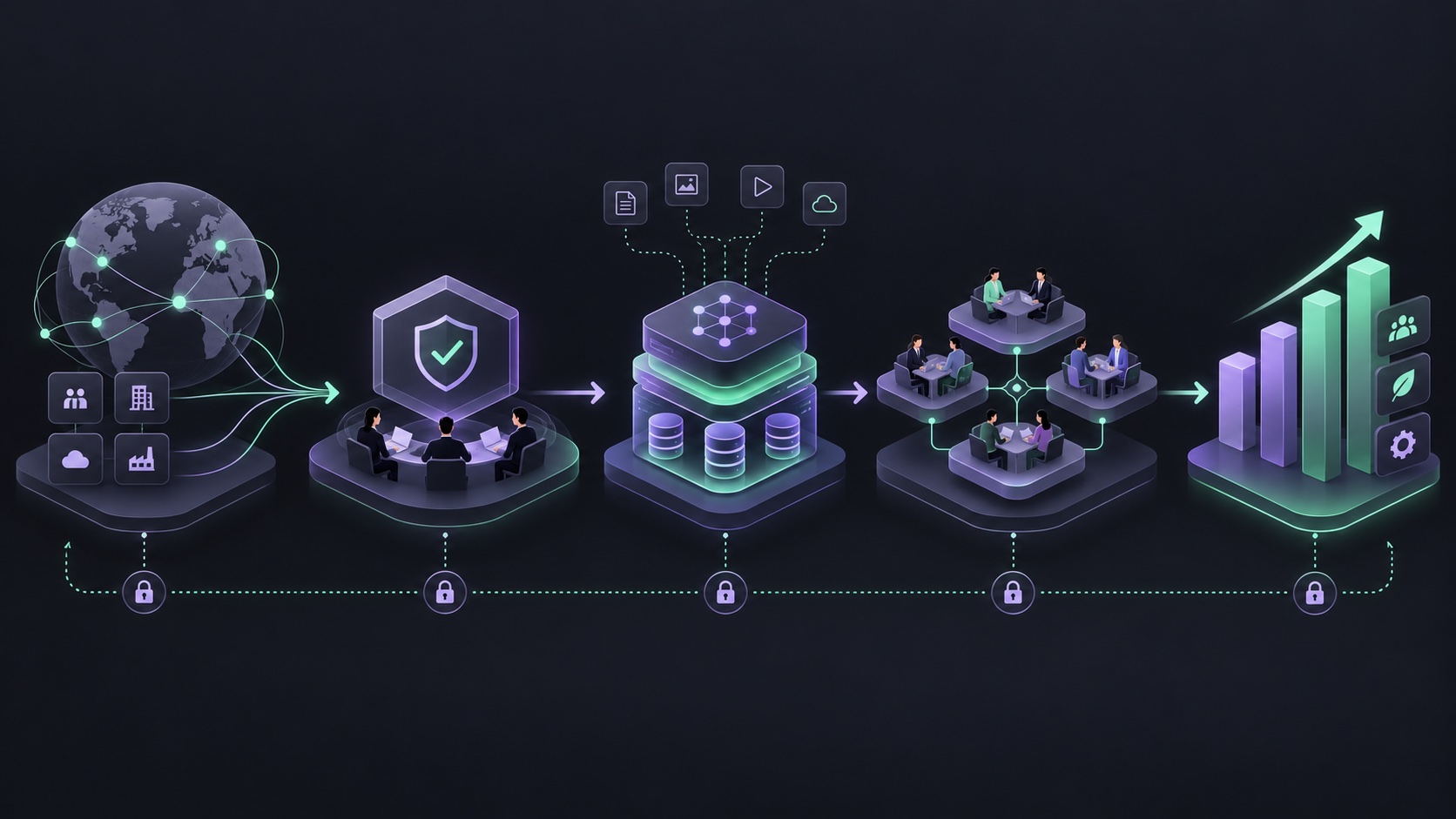
The AI-enabled GCC operating system
The architecture of an AI-enabled GCC is organisational and technical at the same time. Five connected layers should be visible in the proposed model.
- Enterprise direction: a defined mandate, roadmap, funding model, decision rights and business outcomes.
- Governance spine: architecture, security, risk, finance, portfolio and human approval controls that operate inside delivery.
- Shared foundations: cloud, data, developer platforms, identity, observability, AI tooling and reusable delivery standards.
- Product and capability teams: persistent, multidisciplinary squads aligned to products, platforms or value streams.
- Evidence loop: operational measures, user feedback, quality signals and business results that reshape the roadmap.
If one layer is missing, the weakness appears elsewhere. Teams without a mandate become a ticket queue. AI teams without governed data stay in pilot mode. Governance without embedded workflows becomes review overhead. Platforms without persistent product teams become unused infrastructure.
This is why the partner should present one integrated design, not separate slides for talent, technology and governance. The interfaces between those elements determine whether the GCC can make decisions and improve continuously.
How the best AI-enabled GCC partners prove readiness
Evidence should match the responsibility being purchased. A recruitment result proves access to talent. A technology case study proves engineering capability. Neither alone proves that a partner can establish and operate an integrated GCC.
- Mandate evidence: examples of centres that progressed from delivery capacity to ownership of products, platforms or business capabilities.
- Production evidence: AI or data services that operate under real security, reliability, cost and support constraints.
- Governance evidence: decision forums, controls, service reporting and escalation paths used in day-to-day delivery.
- Talent evidence: retention, leadership development, specialist learning and succession mechanisms.
- Outcome evidence: a baseline, measurement period and accountable enterprise owner for each reported result.
- Continuity evidence: how product and domain knowledge survives role changes and scales across teams.
Ask for the named delivery leaders who will be assigned to the programme, not only the executives who appear in the proposal. Their experience should cover the specific combination of operating model, technology and organisational change in scope.
A credible 90-day GCC validation plan
Ninety days should validate a bounded initial capability, not promise an entire enterprise centre regardless of scope. A credible plan makes dependencies explicit and ends with a scale, refine or stop decision.
Weeks 1 to 3: define mandate and boundaries
Select one product, platform or capability with an accountable enterprise owner. Define the initial backlog, decision rights, service measures, required roles, access, security constraints and the responsibilities of both parties.
Weeks 4 to 6: establish the delivery system
Mobilise the core team, configure access and environments, agree engineering standards and create the governance cadence. Capture baseline measures before AI tooling or process changes are judged.
Weeks 7 to 10: deliver through the model
Run real work through the proposed system. Test architecture decisions, review controls, product management, knowledge capture, platform use and escalation. The objective is to expose operating friction while the scope is still contained.
Weeks 11 to 13: evaluate and decide
Review delivery evidence, team health, platform readiness, risks, unit economics and stakeholder confidence. The output should be a scale plan with remaining dependencies, not a ceremonial pilot presentation.
Where Softobiz fits
Softobiz fits enterprises that want a long-term GCC operator with AI, data, product and platform engineering inside the same delivery model. The client keeps the roadmap, priorities and intellectual property. Softobiz recruits and manages the centre, establishes governance and keeps the delivery system running.
This approach is relevant when continuity and enterprise integration matter more than assembling interchangeable resources. A company can begin with one dedicated squad, coordinate several product teams or establish a broader offshore function. AI-enabled tooling and shared engineering practices are introduced as part of the operating model rather than treated as a separate innovation programme.
The trade-off is clear. If an enterprise only needs an independent location study, a short-term recruitment burst or administration for a fully designed internal model, a specialist adviser or talent provider may be simpler. Softobiz is most useful when the requirement combines centre setup with ongoing engineering ownership.
Explore the Softobiz Global Capability Centre model, the 90-day GCC offer and the guide to high-impact GCC operating models before building the shortlist.
Questions to ask every shortlisted GCC partner
- What will the centre own after the first year that it does not own on day one?
- Which decisions remain with global leadership, and which move into the GCC?
- How do AI experiments become supported production services?
- Which shared data, cloud and developer platforms are required?
- How will the centre develop technical leaders and reduce dependency on provider specialists?
- What happens when a key role is unavailable or an integration is delayed?
- Which measures show that capability and ownership are scaling, not only headcount?
- Who owns day-to-day operations, security exceptions and service recovery?
- What will the production operating model cost after the initial mobilisation?
- Which named leaders will remain accountable after the agreement is signed?
Frequently asked questions
What is an AI-enabled Global Capability Centre?
It is an enterprise capability centre where AI, data and modern engineering are embedded in the operating model. Teams own defined products or capabilities, use governed shared platforms and remain accountable for production outcomes rather than supplying isolated technical capacity.
Should AI capability be centralised in a GCC?
Shared foundations, governance and specialist expertise often benefit from a central platform or centre-of-excellence layer. Product decisions and adoption should remain close to domain teams. The strongest model combines reusable foundations with distributed product ownership.
How long does it take to establish an AI-enabled GCC?
A bounded initial team and delivery system can be validated within about 90 days when leadership, roles, access, security and setup dependencies are ready. A full centre should be phased according to its mandate, locations, regulatory requirements and integration complexity.
How is a GCC different from staff augmentation?
Staff augmentation adds individual capacity to an existing organisation. A GCC establishes persistent teams, leadership, governance, platforms and institutional knowledge around an enterprise mandate. The value comes from accumulated ownership and context, not only the number of people supplied.
Who should own the roadmap and intellectual property?
The enterprise should retain the roadmap, priorities and intellectual property. A partner can operate the centre and take responsibility for delivery, staffing and governance while those strategic rights remain with the client.
The best AI-enabled GCC partner builds an ownership engine
The best AI-enabled GCC partners align operating model, engineering, talent and governance around a mandate the enterprise is prepared to fund and measure. They do not treat AI as a specialist team on the side or a tool licence layered onto a traditional offshore structure.
Choose the partner model first, score candidates against the six criteria and validate the design through real delivery before scaling it. If your organisation needs a capability centre that can own AI, data and product engineering over the long term, talk to Softobiz about the first operating slice.
Methodology note: This article provides an enterprise buyer's framework derived from the supplied comparison brief, public GCC policy material and Softobiz's published operating model. It is not an audited third-party ranking.