
Best Distributed AI Engineering Teams for Enterprises in 2026: A Buyer’s Guide
The best distributed AI engineering teams are not loose collections of remote specialists. They are persistent, cross-functional teams that can turn enterprise priorities into production AI systems while preserving context, control and accountability across locations.
That distinction matters in 2026. AI coding tools can increase individual output, but enterprise value still depends on architecture, data quality, evaluation, security, product judgment and reliable operations. A distributed team works when those responsibilities form one delivery system, not when work is divided into disconnected tickets.
This guide is a best-fit framework, not a vendor ranking. It explains how to compare team models, what evidence to request and how to validate a partner through real delivery before making a larger commitment.
Key takeaways
- The strongest distributed AI team owns a product, platform or measurable business capability, not just a backlog of tasks.
- AI depth must include data engineering, evaluation, MLOps, platform engineering, security and operations, not only model experimentation.
- Continuity, decision latency and institutional memory are as important as access to specialist talent.
- The right commercial model depends on whether you need a persistent product squad, a platform team, managed delivery, specialist augmentation or a GCC-integrated network.
- A 90-day validation should test one production-shaped operating slice with measurable outcomes and explicit scale criteria.
What defines the best distributed AI engineering teams in 2026
A distributed AI engineering team is a stable group of product, data, machine learning, software, platform and quality specialists working across locations against one mission. It has shared priorities, defined decision rights, common engineering standards and collective accountability for what happens after deployment.
This is different from remote staffing. A staffing model supplies people into a structure the enterprise already owns. A distributed engineering model provides a team-shaped capability with leadership, operating cadence, technical foundations and responsibility for outcomes. Either can be useful, but buying one while expecting the other creates predictable friction.
The difference is especially important for AI. A model can perform well in a demonstration and still fail under real data, cost, latency, safety or support constraints. The team must connect discovery, data preparation, model and application engineering, evaluation, release, observation and improvement. That work crosses more functions than a conventional software feature.
Google Cloud's 2025 DORA research describes AI as an amplifier of an organisation's existing strengths and weaknesses. That is a useful buying principle. If a distributed team has clear ownership, strong platforms and fast feedback, AI can increase throughput. If the delivery system is fragmented, faster code generation may simply move bottlenecks into review, integration and operations.
Six criteria for evaluating the best distributed AI engineering teams
A weighted scorecard keeps the selection focused on the operating system you are buying. Agree the relative importance of the criteria with product, technology, data, security, finance and business leaders before reviewing proposals.
1. AI-native systems depth: 20%
Look beyond a list of model providers and certifications. The team should demonstrate how it designs AI features as production systems, including data pipelines, retrieval, model selection, evaluation, guardrails, observability, cost control and fallback behaviour. Ask which decisions are model-driven, which stay deterministic and where human approval is required.
Evidence should include the engineering choices behind a result. A polished prototype proves that a team can explore. It does not prove that the team can operate an AI service under enterprise reliability, privacy and support requirements.
2. Product and platform ownership: 20%
Strong teams receive a bounded mission, not an endless task queue. They can clarify the problem, shape a roadmap, make architecture decisions within agreed guardrails and remain accountable after release. Product and platform ownership reduces hand-offs and gives the team a reason to improve the system rather than optimise isolated deliverables.
Ask what the team will own after three, six and twelve months. A credible answer should describe expanding decision rights, service responsibilities and measurable outcomes, not only increasing headcount.
3. Delivery alignment and decision latency: 15%
Time-zone overlap matters, but overlap alone does not create alignment. Evaluate how product decisions are made, how requirements are clarified, how architecture and security questions are resolved and how quickly blocked work reaches the right owner.
The best distributed teams create deliberate collaboration windows and preserve focused delivery time. They use written decisions, visible backlogs, lightweight design records and predictable ceremonies so that progress does not depend on one recurring meeting or one person staying online late.
4. Continuity and institutional memory: 15%
AI systems accumulate context about data, prompts, evaluations, users, controls and operational edge cases. Frequent rotation destroys that knowledge. Assess team stability, succession, documentation, pairing, onboarding and the way important decisions become reusable organisational memory.
Continuity is not a promise that nobody will leave. It is a system that prevents any one person's absence from stopping delivery or weakening control. Ask to see the actual knowledge practices and replacement plan, not only a retention percentage.
5. Governance, evaluation and operability: 15%
Governance should live inside delivery. The NIST AI Risk Management Framework places governance, testing, evaluation, verification and validation across the AI lifecycle. A partner should be able to show how those principles become day-to-day controls: evaluation suites, approval thresholds, data access rules, release evidence, monitoring, incident response and model-change records.
Ask how the team detects degraded behaviour, unsafe outputs, drift, rising cost or upstream data changes. The answer should identify owners, signals and recovery actions. A policy without an operating mechanism is not evidence of control.
6. Economic transparency and measurable value: 15%
Compare the cost of the operating capability, not only the rate for each role. Include mobilisation, leadership, platforms, model usage, cloud infrastructure, quality, security, support and the cost of enterprise coordination. A low headline rate can become expensive if the client must supply missing product, architecture or operational ownership.
Measures should connect delivery to value. Useful examples include cycle time, release reliability, evaluation pass rate, service availability, model or inference cost per transaction, adoption, time saved and the percentage of a product roadmap owned by the team. Every metric needs a baseline, source, owner and review cadence.
Choose the team model before choosing a provider
The phrase distributed AI team covers several different arrangements. Start with the responsibility you want the team to hold, then compare providers that are designed for that job.
Embedded AI product squad
Best suited to an enterprise with an established product and platform environment that needs a persistent team for one product or value stream. The squad usually combines product, software, data, ML and quality skills. The trade-off is that the enterprise must provide clear access to business owners and shared platforms.
Distributed AI platform team
Best suited to organisations building shared capabilities such as data products, model gateways, evaluation services, observability, identity or developer tooling. The advantage is reuse across product teams. The trade-off is that platform demand and adoption must be actively managed or the team can build infrastructure without committed users.
Managed delivery team
Best suited to an enterprise that wants a partner to take responsibility for a defined roadmap, staffing, delivery management and service outcomes. This model can reduce coordination burden, but scope boundaries, decision rights and commercial incentives must be explicit.
Specialist augmentation
Best suited to a mature internal team with clear architecture and leadership that needs a small number of scarce skills. It is flexible and fast to start. The trade-off is that the client retains integration, continuity and outcome accountability.
GCC-integrated engineering network
Best suited to enterprises combining global product leadership with a persistent capability centre and specialists across regions. It can create deep institutional knowledge and access to a broader talent system. The trade-off is greater operating-model complexity. Decision rights, platform ownership and the interfaces between teams must be designed before scale.
An enterprise can combine models. If it does, name the integrator and make the seams visible. Somebody must own the gaps between product, data, models, platforms, security and operations.
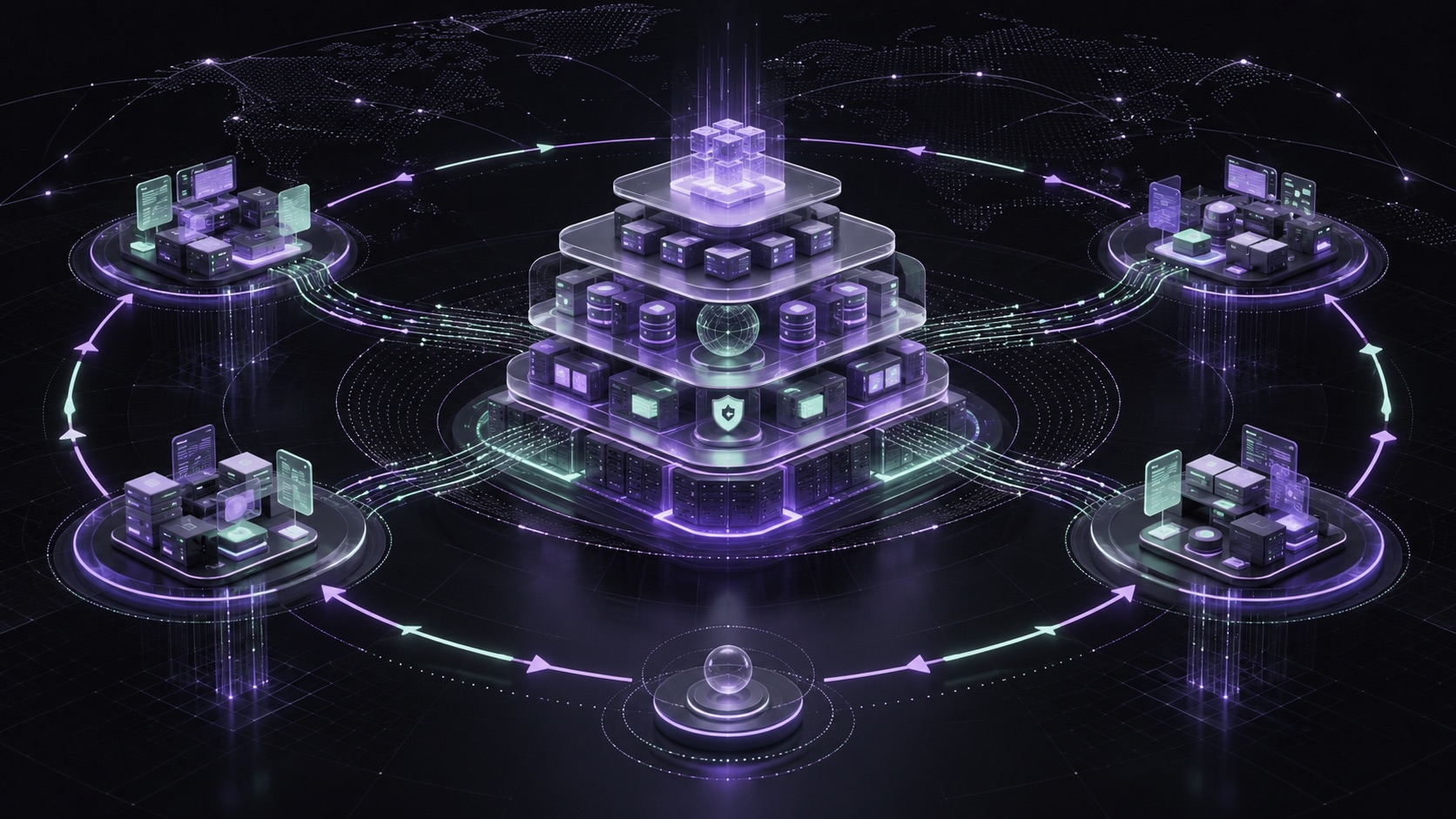
The distributed AI engineering operating system
The strongest distributed teams connect five layers. Together they turn remote collaboration into a repeatable production capability.
- Enterprise mandate: a bounded mission, accountable sponsor, funding model, roadmap and measurable outcomes.
- AI and data foundation: governed data access, development environments, model and retrieval services, evaluation tooling, identity, observability and reusable standards.
- Persistent squad topology: stable product and platform teams with the skills and authority to take work from discovery through operation.
- Embedded governance: architecture, security, risk, privacy, cost and human-approval controls that run inside the delivery workflow.
- Evidence loop: product usage, model quality, operational signals, cost and business results that continuously reshape priorities.
If one layer is weak, the symptoms appear elsewhere. Teams without a mandate become a ticket queue. AI teams without governed data remain in prototype mode. Governance without workflow integration becomes review overhead. Platforms without committed product teams become expensive shelfware. Metrics without owners become presentation material rather than decisions.
Enterprises can strengthen these foundations through a clear delivery model, a reusable enterprise AI capability and governed data and analytics foundations.
Proof enterprise buyers should demand
Evidence should match the responsibility being purchased. A staffing success proves talent access. A model demonstration proves experimentation. Neither alone proves that a team can own a production AI capability.
- Production evidence: systems operating under real security, reliability, latency, cost and support constraints.
- Evaluation evidence: repeatable tests, failure taxonomies, release thresholds and a process for regression management.
- Ownership evidence: teams that progressed from an initial backlog to responsibility for products, platforms or services.
- Governance evidence: controls, decision records, escalation paths and incident practices used in routine delivery.
- Continuity evidence: onboarding, knowledge capture, succession and role-cover practices that have survived personnel changes.
- Outcome evidence: a baseline, measurement period, data source and accountable enterprise owner for each claimed result.
Ask to meet the delivery leaders who will remain accountable after the contract is signed. Their experience should match the combination of domain, AI system, platform and organisational change in scope.
A credible 90-day validation plan
Ninety days should validate one bounded operating slice. It should not promise an enterprise-wide transformation regardless of access, data and governance readiness.
Weeks 1 to 3: define the mission and evidence
Select one product, workflow or platform capability with an accountable enterprise owner. Define the users, baseline, success measures, data boundaries, decision rights, evaluation approach, required roles and production constraints. Make dependencies visible before delivery commitments are finalised.
Weeks 4 to 6: establish the delivery system
Mobilise the core team, configure access and environments, create the initial evaluation set, agree engineering standards and establish governance and operational cadences. Record baseline measures before AI tools or process changes are judged.
Weeks 7 to 10: deliver through the model
Run real work through the proposed system. Test discovery, architecture, data quality, model behaviour, product review, release controls, observability and escalation. The objective is to reveal operating friction while the scope is still contained.
Weeks 11 to 13: evaluate and decide
Review delivery evidence, AI quality, operational readiness, team health, risks and unit economics. End with a scale, refine or stop decision. A scale plan should state which dependencies remain and which responsibilities can safely expand.
Where Softobiz fits
Softobiz fits enterprises that want persistent distributed teams for AI, data, product and platform engineering rather than a stream of interchangeable resources. The client retains the roadmap, priorities and intellectual property. Softobiz helps shape the team, establish the delivery system and take responsibility for agreed engineering outcomes.
This model is most relevant when the work needs continuity, cross-functional ownership and integration with enterprise platforms. A company can begin with one product squad, add a shared AI platform team or connect the model to a broader Global Capability Centre. When ongoing production support matters, AI managed services can extend the same control and evidence model into operations.
The trade-off is clear. If an enterprise needs only independent strategy advice, short-term recruitment or one specialist inside an already mature team, a narrower provider may be simpler. Softobiz is most useful when the requirement combines engineering depth with long-term ownership.
Questions to ask every shortlisted partner
- What product, platform or business capability will this team own?
- Which decisions can the team make, and which remain with enterprise leadership?
- How do experiments become governed, supported production services?
- How are data, model and application changes evaluated before release?
- What evidence shows that the team can operate the system after launch?
- How is product and domain knowledge protected when people change?
- Which collaboration hours are essential, and which work is designed to be asynchronous?
- What client roles and platform dependencies are assumed in the proposal?
- How will cost per outcome be measured as usage and model choices change?
- Which named leaders will remain accountable after mobilisation?
Frequently asked questions
What is a distributed AI engineering team?
It is a persistent, cross-functional team that works across locations and owns an AI product, platform or capability from discovery through production operation. It typically combines product, software, data, machine learning, platform and quality expertise under shared priorities and controls.
How is a distributed AI team different from staff augmentation?
Staff augmentation adds individuals to an operating model the client already owns. A distributed AI team provides a team-shaped capability with leadership, working practices, shared accountability and continuity. The enterprise should choose based on whether it needs skills inside its system or an accountable delivery system around those skills.
Should every AI engineer work in the same time zone?
No. Teams need enough overlap for product decisions, design work, incident coordination and relationship building. Focused engineering can happen across time zones when decisions, documentation, environments and hand-offs are designed for asynchronous work.
Which roles belong in a distributed AI product squad?
The exact mix depends on the product, but a production-shaped squad normally covers product leadership, software engineering, data engineering, machine learning or applied AI, platform or MLOps, quality and design. Security, privacy and domain experts may be embedded or available through a shared governance layer.
How long does it take to validate a distributed AI team?
A bounded operating slice can usually be tested within about 90 days when sponsorship, access, data and security dependencies are ready. Building a mature enterprise capability takes longer and should expand in stages based on evidence.
The best distributed AI engineering teams build compounding capability
The best distributed AI engineering teams combine specialist depth with persistent ownership. They align product, data, models, platforms and governance around a mission the enterprise is prepared to fund and measure. Location becomes an operating design choice, not a substitute for design.
Choose the team model first, score potential partners against the six criteria and validate one production-shaped slice before scaling. If your organisation needs an AI engineering team that can own outcomes across locations, talk to Softobiz about the first operating slice.
Methodology note: This article provides an enterprise buyer's framework derived from the supplied comparison brief, public DORA and NIST material, and Softobiz's published delivery model. It is not an audited third-party ranking.